As International Development Week 2026 comes to a close, revisit stories of global partners' faithful work towards a more just world.
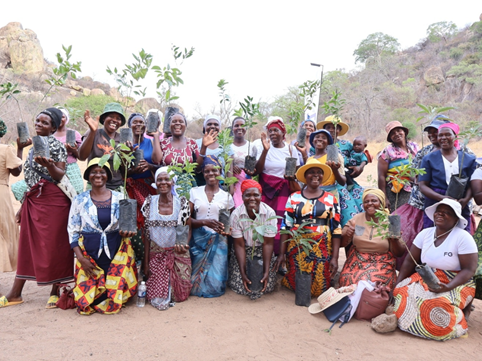
As International Development Week 2026 comes to a close, we give thanks for the partners, volunteers, and communities who remind us that hope is not abstract, not intangible—it is an embodied practice.
When worldly systems fail to prioritize the hungry, the displaced, the widow, and the vulnerable, we are called again to God’s vision. Where compassion is a public practice, and where our neighbour is never a stranger. At the same time, we call on our leaders to meet our international obligations to address our deeply connected global challenges. International development is not charity; it is a commitment to our shared future—financially, environmentally, socially, and in the pursuit of lasting peace.
We must resist narratives of scarcity or the false “either/or”. The pressures facing communities in Canada are real and need addressing. At the same time, God’s call remains—to love broadly, act courageously, and walk together toward justice.
Stories from International Development Week 2026
- February 2 — The Pastoral and the Prophetic: Churches Advancing Food Sovereignty and Justice
- February 3 — “God Created Me Equal”: Indigenous Women Claiming Leadership Through Contextual Theology
- February 5 — Restoring Land, Restoring Hope: Conservation Agriculture in Kenya
- February 6 — Call to Honour Creation: An Indigenous Youth Voice in Belém
This year, International Development Week coincided with the International Year of Volunteers for Sustainable Development. Across the stories shared this week, volunteers and community leaders are at the heart of change; from Indigenous women giving their time to lead theology circles; to farmers teaching other farmers climate-resilient practices.
We give thanks, too, for United Church people:
- Volunteering in their local communities
- Participating in global partnership pilgrimages
- Serving on committees, working groups, and advocacy teams
- Giving generously of time, prayer, and resources
Your faithfulness—often unseen—is part of how hope is kept alive.
“Let us not grow weary in doing what is right.”
(Galatians 6:9)
How Can You Accompany Global Partners and Justice in 2026?
- Give to Mission and Service to help support Canadian and global partners working towards meeting the Sustainable Development Goals. To support Canadian Foodgrains Bank-related projects, please specify that in your donation.
- Advocate for change to climate policies with the Canadian government and other decision-makers.
- Pray with your community: for justice, courage, and right relationship in a fragmented world.
- Share your story: tell us how your community of faith plans to engage this work at justice@united-church.ca.
- Use the Reflection Questions provided in each story in Sunday schools, youth groups, and small groups.
- Learn more about the work of Indigenous Ministries by following the Church Indigenous Ministries Facebook page, the Indigenous Ministries webpage, and supporting their advocacy initiatives.
- Support United Church programming at the Canadian Foodgrains Bank. Many United Church people and congregations contribute by supporting growing projects in their local areas.
- Support initiatives in your local community that alleviate poverty and support youth. Many United Church community and social justice ministries offer grassroots programs and services.
- Use the Reflection Questions provided under each story this week in Sunday schools and small groups at your community of faith.
- Follow United Action for Justice on Facebook and Instagram, as well as United Church News and the Round the Table blog for more information on how your community of faith can get involved.
Behind the Goals: Building an Economy of Life
International Development Week also invites us to look beyond individual projects and ask harder questions about the systems shaping them. The Sustainable Development Goals do not exist in isolation; they sit within a global economic and governance framework that is increasingly unequal, extractive, and misaligned with care for people and planet. Without meaningful reform to these systems, progress on poverty reduction, climate action, food security, and peace will remain fragile and uneven.
This is why the World Council of Churches’ New International Financial and Economic Architecture (NIFEA) process matters. Through NIFEA, the World Council of Churches is working with a broad coalition of global faith partners—including the World Communion of Reformed Churches, the Lutheran World Federation, the World Methodist Council, the Council for World Mission, and United Society Partners in the Gospel—to bring ethical, faith-rooted voices into global economic discussions and re-imagine international finance and governance in ways that prioritize human dignity, ecological sustainability, and democratic accountability.
These collaborative efforts engage church and community perspectives on debt justice, fair taxation, climate finance, and the deep reforms needed in global economic governance. They also feed into educational spaces like the Ecumenical School on Governance, Economics, and Management (GEM School), which is a collaborative learning initiative grounded in NIFEA’s principles that equips participants with the tools to understand global economic structures and advocate for systemic change.
As part of International Development Week, we invite you to explore the NIFEA process, reflect on how global economic systems shape progress toward the SDGs, and consider signing up for the GEM School (support is available through the United Church website) to deepen your understanding and action for a just, sustainable global governance that works for all. Applications close February 20, 2026.
The views contained within these blogs are personal and do not necessarily reflect those of The United Church of Canada.