
Rev. Franklyn James on Black History Month, A Place at the Table, and the importance of truly reflecting on identity
Read the first part of Rev. Franklyn James’ reflection, published earlier this month: A Place at the Table: What the Photograph Couldn't Say (Part One)
A question came to the fore in my mind as we celebrate Black History Month and honour Black people, in Canada and in the United Church.
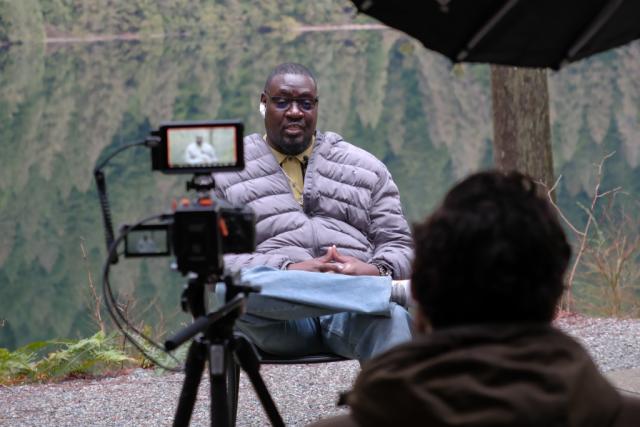
There was a moment at the A Place at the Table photo shoot last summer when a question about whether my ear bandage might signal political allegiance momentarily caught me off guard. I was reminded how quickly our bodies can be read, or misread, through lenses not our own. That moment, and the wider question of who is missing from the table, pushed me toward a deeper reflection: Who is fully embraced at the table?
What happens when someone shows up with a different theological vision of Christianity than the dominant one in the room? What if my political commitments do not align with the group’s assumed consensus? Will those differences de-centre my Blackness, or cast suspicion on my belonging?
These questions led me to wonder about how identity is understood and honoured within community. Are Black people and other marginalized groups only viewed as those in need of rescue or advocacy? What would it mean to truly recognize our agency, tenacity, courage, and strength?
Black people across this country are navigating real challenges and deserve support, but that support must not come at the cost of being reduced to victims or defined solely by struggle. The fullness of Black experience includes grief, yes, but also brilliance, joy, and moral clarity. To celebrate Black History Month is to tell the whole story, not just of what we have endured, but of how we have led, created, resisted, and reimagined.
These are the quiet tensions that live underneath representation. For Black presence to mean more than visibility, it must include space for nuance, disagreement, and the complexity of being seen as a full person.
For me, the session that I co-led as part of the United Church’s 40 Days of Engagement on Anti-Racism was my first opportunity to reflect on the A Place at the Table photo from an outside perspective. It was a chance to return to the depth of what we lived. It was a chance to say: the table is wide. It always was. No single narrative can carry the whole truth.
I now ask the church a simple question:
How do we keep the table honest about race, culture, language, queerness, and all of the identities the United Church names as part of its community, and do so with care and integrity?
That is the work of anti-racism.
That is the work of full participation of all peoples and all identities.
That is the work of intercultural ministries.
That is what it means to live into our equity aspirations.
And for me, that is the heart of what A Place at the Table was meant to be.
In 2025, I showed up with my full Blackness: Jamaican-born, preacher, poet, and public witness, diasporic and embodied, telling a story about what it means to belong without dilution.
This Black History Month, Black stories must remain in the conversation. We are called to celebrate Black presence as essential, central, and worthy of continued attention. It is a presence that is foundational to the life, faith, and future of the church. And we, as Black people, must continue to center ourselves—refusing to let others define our voice, dictate our values, or decide how we should act, think, or feel.
—Rev. Franklyn James, originally from Jamaica, is minister at West River United Church in Cornwall, Prince Edward Island.
Read “The Journey Worth Taking,” a poem written by Rev. James at the A Place at the Table gathering, in the downloads below.
The views contained within these blogs are personal and do not necessarily reflect those of The United Church of Canada.
Downloads
- The Journey Worth Taking (166.93 KB) (PDF)