
Rev. Franklyn James on Black History Month, A Place at the Table, and the importance of truly reflecting on identity
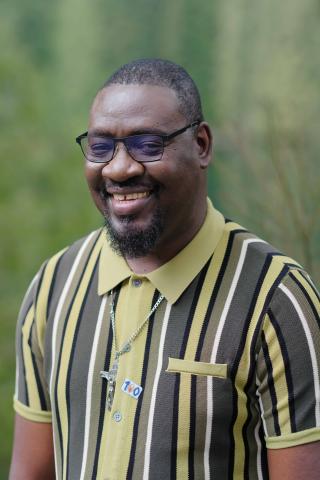
Last year, I was asked to lead a live session as part of the United Church’s 40 Days of Engagement on Anti-Racism education and action program. The topic for my session was viewing A Place at the Table, the photograph taken for the United Church’s centennial, through an anti-racist lens. For me, the photograph was lifted up as a living symbol of the church’s ongoing commitment to inclusion, justice, and the radical hospitality of Christ.
When I arrived in Loon Lake, British Columbia—the location where we gathered to take the photo—I was carrying much more than luggage. I had minor ear surgery the day before and had flown across the country from my home in Prince Edward Island feeling tired, sore, nervous, and oddly excited. Something in me knew this gathering was going to shape the months, or even years, ahead.
The setting greeted me long before the people did. The log-cabin lodge, the fog rolling over the lake, the towering trees. It wasn't just secluded; it felt curated, like a scene lifted straight from a storybook, almost suspended from ordinary life. There was energy in the room as familiar faces and new ones met again. I also felt the alertness that comes naturally to me in diverse identity-conscious spaces.
At one point, a question about whether my ear bandage might signal political allegiance momentarily jolted me out of the dreamlike landscape I had been inhabiting. It reminded me that politics sits close to the surface in gatherings like these. Still, the overall tone was warm, friendly, and high-spirited.
The first group gathering surprised me more than anything. Instead of watching myself from the outside, I felt myself settling in. There was a sense of belonging that came from the intersection of different identities in the room. I found myself leaning in, letting my guard drop a little. It felt like a place where I could be present rather than interpret myself for others.
Every evening we shared our stories. We named why we had come and what we carried.
When it was my turn, I spoke from a part of myself that often gets overshadowed. I lifted up my African descent, my Jamaican heritage, my accent, my migration story—my Blackness. I named the reality that in many spaces, I am welcomed for one part of who I am while being ignored or erased because of the color of my skin. The group received my story with compassion, surprise, and genuine interest. I felt truly seen, not for what others expected, but for the part I know myself to be—fully Black.
The week also pushed me beyond my comfort zone. There were moments of joy too—breaking into a dance, dropping to the ground in sheer laughter. I watched as members of the group attempted handstands. I was smart enough to pull four chairs together, lie down, and enjoy the show. The whole room felt lighter. Those moments felt like grace arriving through humor.
Later in the week, I was asked to write a poem on the spot inspired by an evening sharing circle. I wrote “The Journey Worth Taking,” drawing from the energy and emotions in the room (it’s available to read in the Downloads section below). I felt affirmed as a poet in a new way. I was carried by the spirit of the moment and proud that I could craft something true without time to research or refine. It was a moment that showed me what we can create when we trust our own voices.
When the week ended, I left with a deep sense of community and pride in what we accomplished together. I also left with curiosity, the same feeling I arrived with.
Looking back now from the vantage point of Black History Month 2026, I notice that the public conversation surrounding A Place at the Table has leaned heavily toward 2S and LGBTQIA+ representation. That focus is not wrong; it reflects a genuine and necessary hunger for visibility. But it is also incomplete.
As we mark Black History Month, I am reminded that Black presence at tables is still too often perceived as symbolic rather than structural. My body in that photograph carried more than my own individual story. It carried the weight of generations who were denied seats at the table, who built the tables, and who were still told to wait outside.
At the beginning of this journey, the table held a wide range of identities. Diversity of race, culture, language, disability, migration, rural and urban experience, generation, and sexuality were all present. The table was never meant to spotlight a single story. It was meant to hold many.
My concern is not that queerness is being centered. I live that identity. My concern is that race, language, accent, and cultural experience can slide into the background unless we speak about them with intention and clarity. These identities mattered deeply at Loon Lake. They shaped how people showed up, how stories were told, and how we became a community. They shaped me.
If the story that reaches the wider church highlights only certain identities, then it reshapes the meaning of the table. The table becomes narrower without anyone intending to narrow it. That is the risk of representation without reflection.
This reflection will be continued in a second blog post next week.
—Rev. Franklyn James, originally from Jamaica, is minister at West River United Church in Cornwall, Prince Edward Island.
The views contained within these blogs are personal and do not necessarily reflect those of The United Church of Canada.
Downloads
- The Journey Worth Taking (166.93 KB) (PDF)