December 3 is International Day of Persons with Disabilities
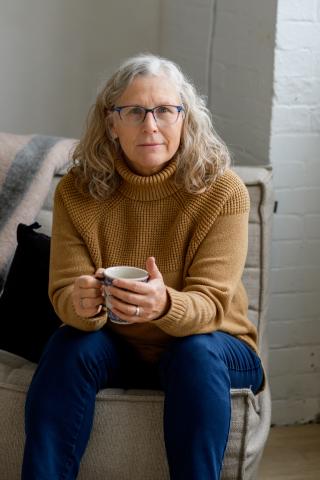
There are two terms which could be used to describe Laura MacGregor of Waterloo, Ontario: “extreme caregiver” and “writer.” Both earned her the CBC Nonfiction Prize earlier this year, for her short story, “The Invisible Woman.”
“Winning the CBC Nonfiction Prize is a huge honour,” she says. “To be in the company of so many talented writers is a thrill. Having my story heard and affirmed by the judges is very meaningful. It also means that I feel a little more comfortable calling myself a writer. The CBC called me a writer, so I must be one.”
MacGregor was a member of the United Church’s former Working Group on Theologies of Disabilities, which was a sub-group of the Theology and Inter-Church and Inter-Faith (TICIF) committee. She is familiar with the challenges and gifts of being an “extreme caregiver,” having cared for her profoundly disabled son, Matthew, until his death at age 21.
The experience of advocating for Matthew to the point of exhaustion led to two discoveries: the presence of her alter ego, Fang, who focused her energy on protecting and advocating for Matthew, and that her faith community failed her family in irreparable ways. MacGregor is writing a memoir “exploring maternal anger directed at a world that did not value my child, experience, labour, or voice as a mother and caregiver.”
Hers and Matthew’s story is one of how some communities of faith are not only unprepared, but are indeed unwilling, to assign true human value to people who have disabilities. December 3 is the International Day of Persons with Disabilities, a day to work towards a more just, accessible, equitable, and sustainable world that understands that advancing progress on social development depends on, and indeed necessitates, the inclusion of all segments of society.
“After Matthew's birth and numerous diagnoses, I expected my faith and my faith community to sustain me and I was deeply disappointed,” she says, noting that there was no conversation about improving accessibility at her community of faith, even though she’d volunteered to spearhead an accessibility committee to figure out a way for Matthew to access the building inside and out in his new wheelchair.
“Over time, my sense of alienation grew. People in my faith community often talked about God never giving me more than I could handle, or always answering prayer, or handpicking me for my ‘special mom’ attributes,” she says. “What they never seemed to be able to hear—despite my attempts to share my experiences—was that Matthew's care was more than I could handle, my prayers felt largely unanswered, and I wasn't and didn't want to be ‘special.’ I was exhausted, isolated, and overwhelmed and needed more than cliched theodicies*. I needed a community who would accept me, confusion and all.”
MacGregor and her family, once very involved in the church, completely withdrew from their faith community, and the hurt has persisted.
“The loss of my faith and my faith community became another casualty, another source of grief,” she says. “Faith is still a cornerstone of our family life in many ways; I just cannot bring myself to attend church. Even now it still feels like loss.”
Did you know?
- An estimated 1.3 billion people experience significant disability. This represents 16 percent of the world’s population, or one in six of us.
- Some persons with disabilities die up to 20 years earlier than those without disabilities.
- People with disabilities have twice the risk of developing conditions such as depression, asthma, diabetes, stroke, obesity, or poor oral health.
- Health inequities arise from unfair conditions faced by persons with disabilities, including stigma, discrimination, poverty, exclusion from education and employment, and barriers faced in the health system itself.
The United Church of Canada has made a commitment to becoming an open, accessible, and barrier-free church, and to welcoming people with disabilities into all aspects of the church’s life. You can learn more about the church’s commitment online, where you can also find worship and educational resources, as well as a link to join the online Disabilities Network.
Our church’s commitments are lived out across the whole church, in real and specific ways in our local communities of faith. Consider how you might make your local church feel and be different for people living with disabilities by next December 3.
*Theodicies is a term for arguments that try to reconcile the existence of an all-powerful, all-good God with the reality of evil and suffering in the world.