In Kenya, the Nature+ program's partnership with communities is improving crop yields, income, and water access, creating lasting change
When we read the story of Jesus feeding the five thousand, we picture a hillside, a hungry crowd, and one small boy’s lunch of a few loaves and a couple of fish. The disciples see scarcity, Jesus blesses what is offered, and suddenly there is more than enough—so much that baskets of leftovers are gathered up. The miracle is not only about bread. It is about what happens when God takes our small gifts, our fragile hope, and multiplies them for the good of many.
Today, that same miracle is quietly unfolding in dry, dusty landscapes in Kenya—Athi in Kitui County, and communities in Tharaka Nithi in Central Kenya. Through the Canadian Foodgrains Bank’s (CFGB) Nature+ program, in which The United Church of Canada is a full member, local churches and communities are seeing land healed, harvests grow, and hope renewed.
A Marketplace of Miracles
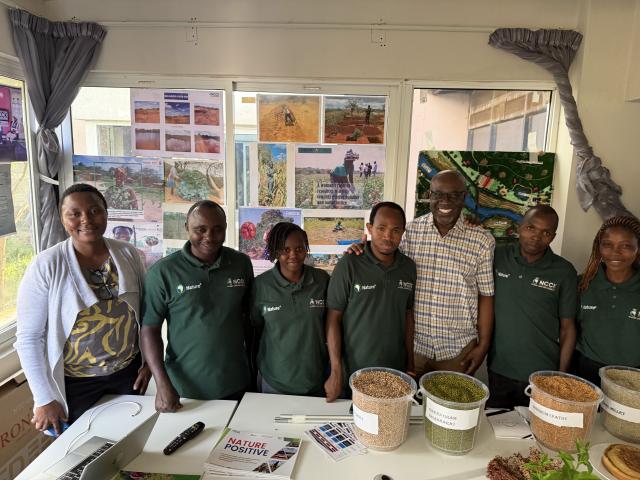
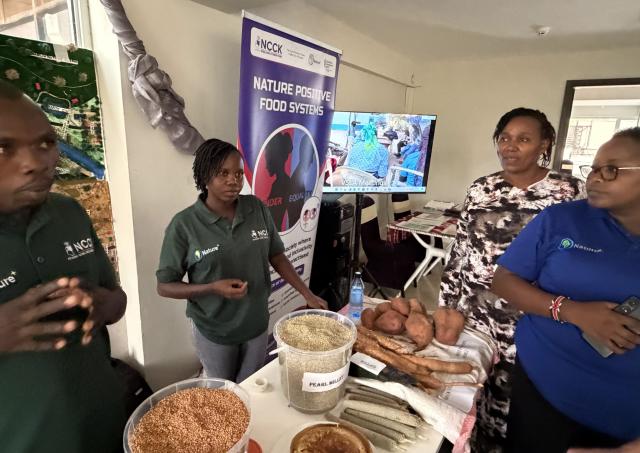
On a recent visit to Kenya, CFGB board members and staff including myself gathered for a “marketplace day” in Kitui. In a hotel hall transformed into a marketplace, farmers and staff from the National Council of Churches of Kenya (NCCK) involved with the project laid out their produce: buckets of green grams, sorghum and cowpeas, bottles of golden honey, bundles of fodder grass, trays of sweet potatoes, cassava cakes, and sorghum “coffee” and other drought-resistant food grains. Each table told a story of change.
One farmer, Matata David, explained how he used to farm a large plot with traditional methods and harvest less than 50 kilograms from half an acre—barely enough to feed his family. After training through Nature+, he shifted to conservation agriculture: ripping the soil into deep furrows, digging pits that catch and hold precious rain, and covering the ground with mulch to keep in moisture. Now, on the same land, he fills three sacks with maize or green grams. There is enough food for his household and surplus to sell at the market. What once felt like a few loaves has become baskets of grain.
Another farmer, Wanzau Makau, shared a similar story of moving from exhausted soil and failed crops to thriving fields, thanks to these same practices. Their testimony is simple but profound: when you “hold the soil, slow the water, and trust the seeds,” as the Nature+ team likes to say, life returns to the land.
Water in the Wilderness
In these semi‑arid communities, failed rains once meant failed harvests. Crops would start well, and then simply wither halfway through the season. People walked long distances for water that was never guaranteed, and the mood each year was anxious waiting for clouds that might never break.
Through participatory planning with the community, the NCCK team and local leaders have helped construct seven earth dams and seven sand dams that now serve about 2,100 households. They capture seasonal flows and store water underground where it is protected from evaporation, turning dry riverbeds into living reservoirs.
Families can now draw water for drinking, kitchen gardens, and small‑scale irrigation. What was once bare sand is slowly becoming green again. Elders point to young trees and remember species they thought were gone forever. Like the disciples looking at baskets of leftover bread, they shake their heads in wonder at what God is doing through their own hands.
Project staff have supported savings groups where members can borrow for new ventures—poultry, rabbit rearing, small shops—spreading risk and opportunity across the community. All of this is part of a broader vision of food sovereignty—people having the power to decide what they grow, how they grow it, and how they share the benefits. It is about multiplying not only food, but choices, voices, and dignity.
Churches at the Heart of Change
Churches are at the centre of this transformation. NCCK works through local congregations, linking practical training in conservation agriculture, water harvesting, tree planting, and livelihoods with biblical teaching about stewardship and justice—echoing the call in Genesis to tend the garden and care for creation. Sermons, Bible studies, and community meetings all reinforce the message that caring for land and neighbours is part of following Christ.
Women, youth, and people with disabilities are encouraged into leadership. Community committees form to oversee water points, protect forests, and manage sand extraction fairly. In Athi Ward alone, Nature+ is directly reaching thousands of participants and impacting many more people in the wider community. Across Kitui and Tharaka Nithi, thousands of households have moved toward food security. Local leaders are beginning to influence county policies around biodiversity and land use.
These numbers are important, but behind each statistic is a family that sleeps with a little less fear at night, a child who goes to school with a full stomach, a community that can weather a bad season without disaster.
Your Loaves and Fish
As United Church people, we sometimes wonder if our offerings—our Mission and Service gifts, our congregation’s harvest events, our advocacy—really make a difference in a world of such deep need. The stories from Athi and Tharaka Nithi are a living answer.
Through the Canadian Foodgrains Bank, our shared gifts are training farmers, building dams, planting trees, restoring degraded hillsides, and helping communities organize for justice. We bring what we have—our loaves and fish, our prayers and partnerships—and place them in Christ’s hands. In Kenya, as in so many other places, those gifts are being blessed, broken open, and multiplied in ways that none of us could have imagined on our own.
The miracle is not magic. It is seeds in the ground, hands in the soil, water held in carefully designed earthworks, women counting savings in a circle, young people inspecting beehives, elders teaching the names of trees to their grandchildren. It is faith made visible in terraces, zai pits, and green shoots pushing through once‑barren land.
—Rev. Dr. Japhet Ndhlovu is Executive Minister, Church in Mission with the United Church of Canada General Council Office, and United Church Representative and Board Member at the Canadian Foodgrains Bank
The views contained within these blogs are personal and do not necessarily reflect those of The United Church of Canada.