Moderator Kimberly Heath reflects on the United Church’s visit to the former residential school, now transformed as an Indigenous-run museum
Content warning: This information may be traumatic for residential school survivors, families, and community. If you are feeling pain or distress, please call the National Residential School Crisis Line at 1-866-925-4419, or the First Nations and Inuit Hope for Wellness Help Line at 1-855-242-3310. Both lines are toll-free and open 24 hours a day, 7 days a week.
“There are no unsacred places,” writes Wendell Berry, “there are only sacred places and desecrated places.”
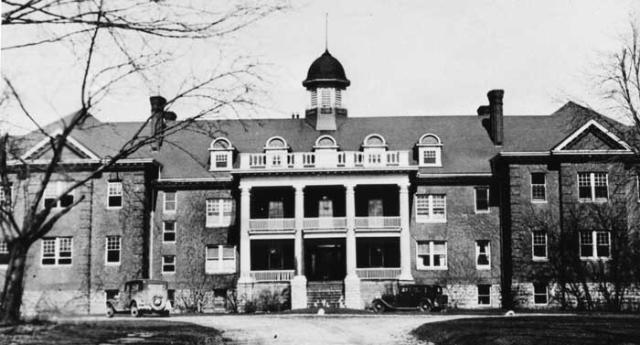
In late April, about 60 staff from the General Council Office and Shining Waters Regional Council, and United Church members from the same region, walked through the halls of the Mohawk Institute on the Six Nations of the Grand River land in Brantford, Ontario.
The Mohawk Institute was a church and government-run residential school—Canada’s longest-running residential school. The United Church operated 15 schools across the country; this one was run by the Anglican Church. From 1828 to 1970, 15,000 Indigenous children from over 60 different locations across the country were forced to walk through the front doors of the Mohawk Institute.
Recently opened as a museum operated by the Woodland Cultural Centre, the space is now gleaming and bright. If you walked through not knowing the history, not reading the information on the walls or listening to the guides or recorded voices of survivors, you would think it was an attractive building.
But there is no hiding from the pain and the ugliness of this place’s history. The students called the school “The Mush Hole” because the food was so bad in quality, taste, and quantity. The food injustice was made worse because for many years, in the 19th and early 20th century, the students were forced to work in the fields to grow fresh produce they never got to eat. The food instead was sold to fund the operation of the school.
Little real education was offered, but plenty of abuse was. The closet under the stairs was used as a cell to imprison children who attempted to run away or who misbehaved—they sometimes remained there for days alone. The laundry room, the boiler room, and the dorms where the children slept were also places of sexual abuse.
Not only was this space hell on earth for the children, but they were not allowed to receive correspondence from their parents; as a result, many thought that their parents, families, and communities had forgotten them. Visits were also discouraged and for many families, the distance would have made visiting nearly impossible.
Many residential schools have been torn down or burnt down in recent years. I can certainly understand the desire to wipe the land clean of these places of pain. But for the Mohawk Institute, a movement was established by Indigenous people to “Save the Evidence.” Even with the stories emerging from the Truth and Reconciliation Commission, there have always been voices that deny the truth of the abuse, neglect, and complete lack of care that was perpetrated in these places.
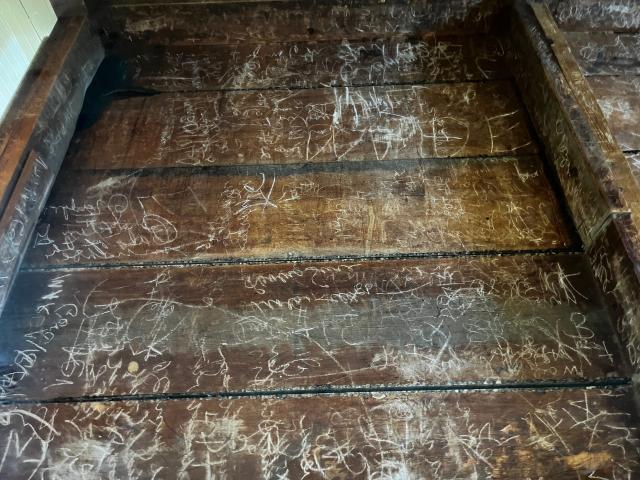
As we walked up the front stairs and through the halls, we experienced history in a deeper place. It is one thing to learn the history of abuse that Indigenous children suffered; it is another to see the names etched under the sewing table by children hiding, or hear the recorded voices of survivors offering memories of their time spent in this place.
The Mohawk Institute is much more than a building. It is more than history. Today, it is a place of real education. I recall the words of the Honourable Justice Murray Sinclair, who famously said: “Education got us into this mess and education will get us out of it.”
Like the resurrected Christ, this building stands with scars, with visible evidence of the torture and harm committed.
But something new is here.
This place of desecration has been transformed into a sacred place of education, justice, and healing. May we continue the work of reconciliation.
—The Right Rev. Dr. Kimberly Heath is the 45th Moderator of The United Church of Canada
The views contained within these blogs are personal and do not necessarily reflect those of The United Church of Canada.