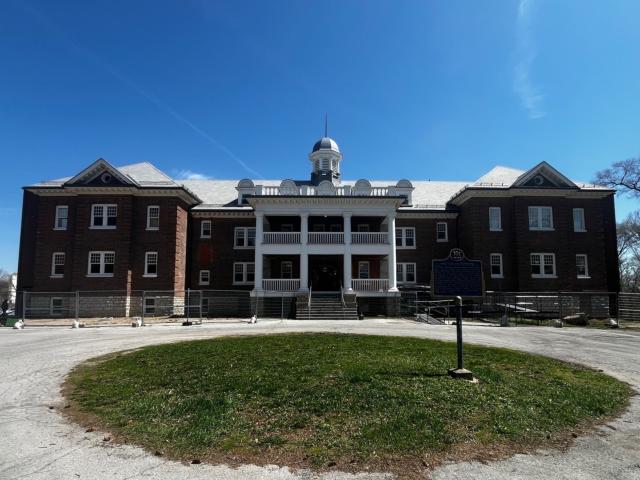
The former residential school, converted by the Woodland Cultural Centre to a museum, preserves a painful history to educate visitors
Content warning: This information may be traumatic for residential school survivors, families, and community. If you are feeling pain or distress, please call the National Residential School Crisis Line at 1-866-925-4419, or the First Nations and Inuit Hope for Wellness Help Line at 1-855-242-3310. Both lines are toll-free and open 24 hours a day, 7 days a week.
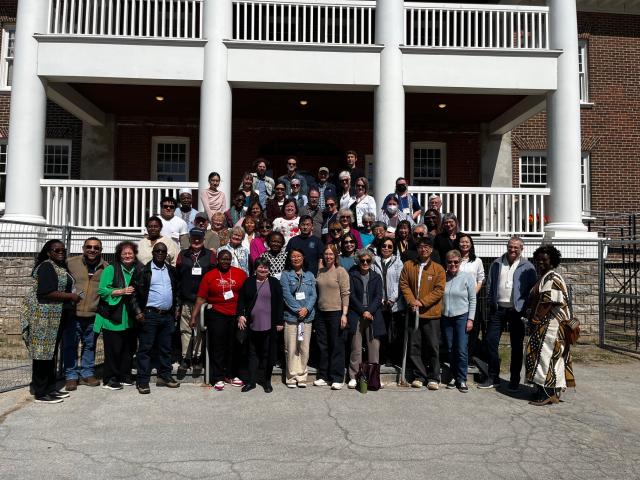
On Thursday, April 23, several United Church of Canada staff and participants visited the former site of the Mohawk Institute Residential School. The site opened as a museum last year by the Woodland Cultural Centre, which is located next door in Brantford, Ontario. The group of 60 included staff from The United Church of Canada’s General Council Office, as well as the United Church’s Shining Waters Regional Council staff and members of communities of faith.
Open in various forms from 1828 to 1970, the Mohawk Institute was the largest and longest-running residential institution in Canada. Originally founded by an Anglican missionary organization, the federal government operated the school after 1929 while maintaining Anglican leadership. An estimated total of 150,000 Indigenous children attended residential schools, and over 15,000 of those children came to the Mohawk Institute. Some of the residents of the Mohawk Institute came from as far as Northern Quebec and throughout Alberta.
Preserving the Evidence
The Woodland Cultural Centre has been open since 1972, working as one guide put it to reverse, where possible, the mission and work of the Mohawk Institute. With a museum building housing over 50,000 artifacts, it aims to “preserve, promote, and strengthen Indigenous language, culture, art and history,” educating visitors on the story and culture of the Hodinohsho:ni people of the Eastern Woodlands.
The Mohawk Institute museum was opened on September 30, 2025—the National Day for Truth and Reconciliation—after a yearslong restoration process. The systemic racism and abuse of its 140-year history is detailed in immersive displays, installed in rooms preserved to resemble how they looked while operational. The museum seeks to preserve the evidence of the residential school system, allowing visitors to bear witness to the grave realities of this chapter in Canada’s history, and their lasting impacts on Indigenous Peoples and communities.
The United Church group was taken on a guided tour of the Institute grounds, beginning with the entrance where students were assigned numbers that served as identifiers in place of their names. Textual displays and audio recordings from survivors throughout the building describe Indigenous students’ experiences there, and the intergenerational trauma that those experiences caused.
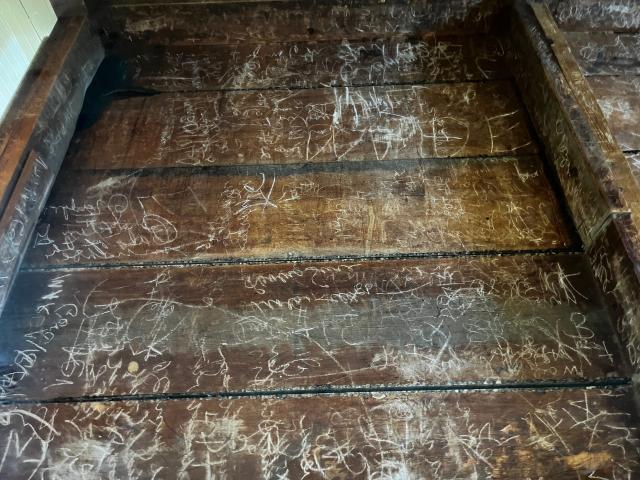
Students were subject to atrocious abuse (physical, sexual, and psychological) at the hands of staff members, including some clergy. The children were punished for speaking their own Indigenous language—regardless of their abilities in English—as well as countless other “infractions” designed to dehumanize and force assimilation upon them. Students had to survive off of inedible meals of “mush,” for which they nicknamed the institute the “Mush Hole.”
It’s estimated that at least 105 students died while enrolled at the Mohawk Institute; many also tried to escape, and the building was burnt down multiple times by students.
Journeying Towards Justice
The tour was followed by a presentation at the Woodland Cultural Centre, detailing the land claims history of the Six Nations of the Hodinohsho:ni. Although the 1784 Haldimand Proclamation entitled the Six Nations to 550,000 acres of land along the Grand River, the Six Nations reserve today makes up only 8 percent of that territory. Guides discussed the significance of the wampum belt in the covenants between Hodinohsho:ni people and settlers, and the group participated in a wampum belt-making craft to conclude the day.
The United Church’s visit was organized as one part of the church’s ongoing work on anti-racism, decolonization, and reconciliation. Participants in the day-long experience are all expected to bring back learnings and ideas to engage in follow up in their own communities and contexts. The time at the Mohawk Institute is also part of the church’s efforts to continue to live into right relations with Indigenous Peoples based in mutuality and respect, and to walk the path of addressing the injustices and inequities that persist to this day as a result of Canada’s colonial legacy.
The United Church of Canada played a direct role in this history, operating 15 residential schools between 1925 and 1969. While the journey towards justice remains long, the church as part of its efforts towards Reconciliation seeks to support the crucial work of institutions like the Woodland Cultural Centre, who honour survivors by telling the stories of this painful history.