When Emmanuel United began using ASL in worship, drawing in Deaf neighbours, the time came to invite the whole congregation to learn to sign
It was over two years ago now that Teisha and Chantal Noseworthy asked Rev. Phil Wilson if he would be willing to baptize both Teisha and their son, Camilo. Phil, a child of Deaf* parents and a United Church minister, had married the couple a few years earlier in an American Sign Language (ASL)-English service. Interestingly, these two baptisms have led to a change for the worshipping community of Emmanuel United in Odessa, Ontario.
As the Noseworthy family began participating regularly, Phil began to include components of ASL in Sunday morning services. Deaf neighbours began to attend, and even established an informal fellowship time before worship. This prompted Emmanuel United to commit funds for ASL interpretation at worship services, a commitment which the United Church of Canada Foundation and East Central Ontario Regional Council provided financial support for. ASL interpretation is now available every other Sunday.
However, this didn’t solve a dilemma which was nagging at Phil. How could their community of faith ensure that there weren’t two separate groups worshipping in parallel; that, instead, it was one community worship together? How could they foster relationships between Deaf and hearing neighbours?
Phil kept coming back to the idea that it would be amazing if hearing members could learn American Sign Language. It would allow for neighbours to talk to one another without the need for a mediator. The challenge, though, is language acquisition would take more than the occasional word or phrase taught to the congregation on Sundays.
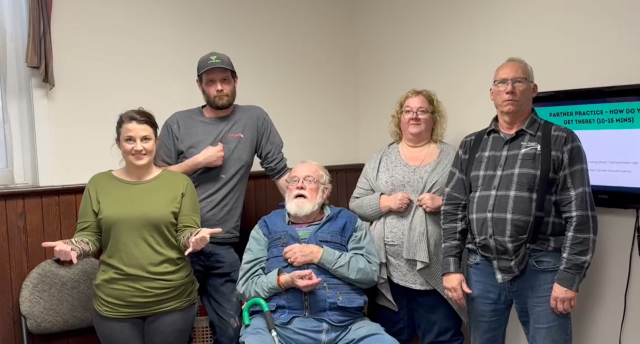
Well, the Spirit was at work. For eight weeks this past fall, a group of about 20 met weekly at Emmanuel United to learn to communicate with their neighbours using their hands, instead of their voices. To explore how they could strengthen community bonds by teaching a new language, Emmanuel received a $5,000 Strengthening Invitation Grant from the United Church of Canada Foundation.
"The hope is that this experience will continue to spark curiosity for all about the lives of our neighbours, and that it will invite community members to not merely worship side-by-side, but welcome each other into their lives."
Accessibility was a huge focus for the entire project. The course was offered at no cost for participants, to remove any barriers for those interested. The Odessa building was chosen because it is barrier-free for those with mobility concerns, and babysitting was also provided. The class welcomed churchgoers and community members—anyone who was open to learning.
Leah Riddell, a qualified ASL instructor, led the one-hour classes, which focused on essential vocabulary and phrases to get neighbours chatting to one another as quickly as possible. As one participant, Jennifer Welch-Wilson, put it: "we are learning words used in general conversation, such as family members, household items, colours, and greetings. Added to our learning is facial grammar and sentence structure.… [Leah] is a skilled instructor, adapting to all learning styles." She also noted that this has impacted her own work as medical secretary at a local hospital, as she is now able to better serve Deaf community members.
The interactive lessons are supported through an online portal where participants can access material taught in class for at-home practice. A level two ASL class is now running with 10 registrants, which will conclude with a celebration to continue to build connections between hearing and Deaf church members.
The hope is that this experience will continue to spark curiosity for all about the lives of our neighbours, and that it will invite community members to not merely worship side-by-side, but welcome each other into their lives.
—This blog was co-written by Rev. Phil Wilson, minister at Emmanuel United in Odessa, Ontario, and Tori Mullin, Growth Animator for Eastern Ontario and Quebec with The United Church of Canada General Council Office
*When capitalized, Deaf refers to a person being culturally Deaf, whether from birth or later in life.
The views contained within these blogs are personal and do not necessarily reflect those of The United Church of Canada.