A lay leader at United Church Plant Emmanuel Iranian Ministries reflects on the enormous loss and injustice in Iran
This reflection was written by Milad, a lay leader at Emmanuel Iranian Ministries, a church plant affiliated with the United Church in Toronto and Newmarket, Ontario. It is based on reports gathered by his community of the brutal repression currently ongoing in Iran, and reflects the very difficult emotions being experienced by those in his community of faith.
Content warning: this reflection contains disturbing descriptions of graphic violence.
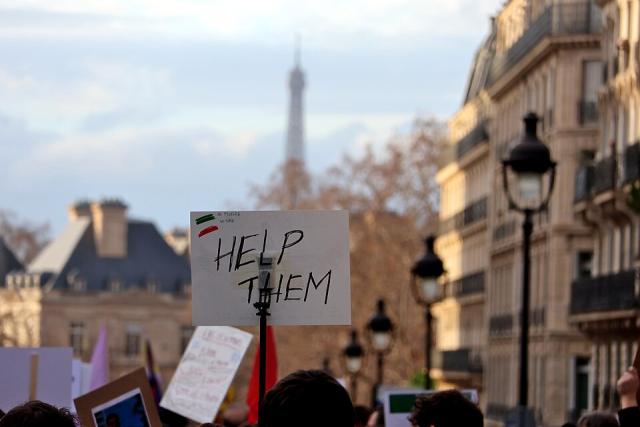
Iran is witnessing an unprecedented human rights tragedy as its hardline regime violently crushes a historic protest movement. What began in late December as peaceful demonstrations against economic hardship has evolved into a nationwide cry for freedom—met with live bullets, mass arrests, and ruthless repression. Under a deliberate communications blackout, Iranian security forces have unleashed what one doctor called “genocide under cover of digital darkness.”
Credible reports compiled by Iranian doctors estimate at least 16,500 protesters killed and over 330,000 injured in just a few weeks, a shocking toll that dwarfs all unrest in Iran since the 1979 Revolution. Even Iran’s Supreme Leader, Ayatollah Ali Khamenei, has reluctantly admitted “several thousands” of his citizens have been killed—an admission as rare as it is horrifying.
Stories of the regime’s atrocities are heart-rending. In one case, a young woman in Isfahan never came home from a protest. Her frantic parents searched for days, only to be shown her lifeless body by security officers. They were given 10 minutes to mourn their daughter and then forced to pay the equivalent of $4,400 as “compensation for the bullet” that killed her. The grieving couple was escorted to an unmarked grave where the authorities had dumped her body. Such cruelty—extorting bereaved parents—lays bare the utter contempt for human life displayed by Iran’s rulers.
On the streets, witnesses describe scenes of carnage. Protesters, many of them teenagers or in their 20s, have been cut down by military-grade weapons. Security forces fire directly into crowds, aiming at heads and chests. Snipers perch on rooftops, picking off people who dare to raise their voices. Armored units have even mounted machine guns on vehicles to rake the streets with bullets. One mother recounted how her 15-year-old daughter—“not a terrorist, not a rioter,” she said—was chased down by Basij militia and shot dead as she tried to run home. “I have not seen scenes like that before,” said one elderly eyewitness of the bloodshed, stunned by the violence unleashed on ordinary people.
Hospitals across Iran are overwhelmed by waves of gunshot victims. Surgeons speak of desperate shortages of blood. Yet in some cases, security agents blocked blood transfusions for wounded demonstrators—effectively condemning them to bleed to death. Many injured protesters avoid hospitals altogether, terrified that they’ll be arrested from their sickbeds; indeed, there are reports of wounded youths dragged off mid-surgery by security forces.
All the while, Iran’s rulers have tried to hide the slaughter behind an information blackout. For over ten days, internet and phone networks were largely cut off. This digital darkness left millions of Iranians isolated, unable to call for help or even know if their relatives were safe. Under cover of this blackout, the Revolutionary Guard, Basij militia, and police units carried out what activists are calling a massacre. “They will turn the country into a graveyard if the world does nothing,” one Iranian journalist warned.
Despite regime propaganda insisting calm has been restored, brief flickers of connectivity and smuggled reports have exposed shocking evidence. Viral videos from a Tehran morgue showed hundreds of corpses of protesters, bloodied and broken, lined up on the floor. “It’s like a genocide in silence,” said one doctor, aghast at the carnage that unfolded while the internet was cut.
As people of faith, we hear the cry of the innocent in Iran. We are called to witness their suffering and refuse to be silent. The Bible teaches us that every person is created in God’s image—their lives are infinitely precious. Yet in Iran today, young men and women are being slaughtered simply for yearning for basic freedom and dignity. This struggle is not about Islam versus Christianity, nor about one country versus another. It is about humanity. It’s about the God-given rights of every human being to live free from terror and oppression. When one part of our human family suffers, we all suffer. As the Apostle Paul wrote, “If one member suffers, all suffer together with it” (1 Corinthians 12:26). We cannot turn away from the pain of our brothers and sisters in Iran.
The international community must not stand idly by. Human rights organizations and Iranian activists are urging the world to take action to stop the bloodshed. “The whole international community’s red lines have been crossed,” warns one prominent human rights advocate, noting that Iran’s authorities are committing “grave human rights violations, mass killings.”
International law asserts a “responsibility to protect” civilians when their own government perpetrates atrocities. That responsibility now falls on all nations—not just one or two—to hold Iran’s regime accountable and protect the lives of Iranian citizens. There are growing calls for global diplomatic action, United Nations intervention, and targeted sanctions against those directing the crackdown. Leaders around the world must hear from people of conscience demanding an end to this carnage.
Lord, in your mercy, hear our prayer. Amen.
The views contained within these blogs are personal and do not necessarily reflect those of The United Church of Canada.