
Rev. Japhet Ndhlovu on boldly, faithfully reading the signs of the times, from Hanover to Toward 2035
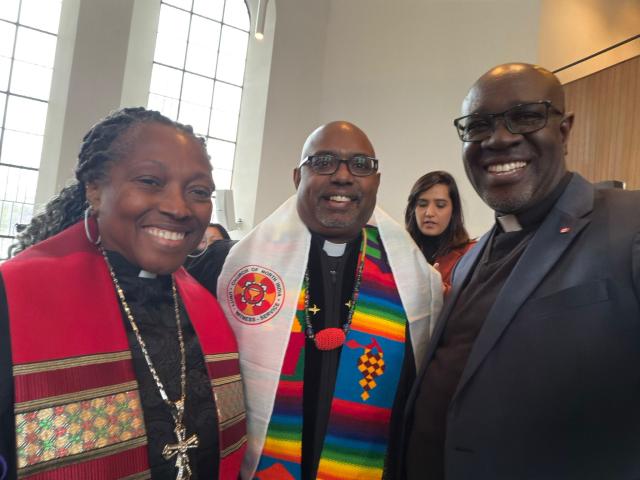
For three intense days in Hanover, the World Communion of Reformed Churches (WCRC) felt less like a “global organization” and more like a living, breathing upper room, full of languages, stories, tensions, and a deeply shared desire to be faithful. Not long after, across the world the United Church of Canada framed its own moment of discernment in Toward 2035. It asked whether we can perceive the new thing God is doing through a church that feels stretched, diminished, and yet still called to Deep Spirituality, Bold Discipleship, and Daring Justice.
In Hanover, the presenting question at the WCRC’s strategic planning meeting was deceptively simple: what does it mean, in 2026 and beyond, to be called to communion and committed to justice? Underneath that lay harder questions: who truly belongs in our koinonia? How do we listen to voices long ignored? How will we act together over the next seven years, and not just speak about justice abstractly?
Toward 2035 names a parallel set of questions for the United Church of Canada. In the face of declining participation and changing neighbourhoods, what purpose lies at the heart of our life together? Can we imagine resilient, inspired, diverse communities embodying Christ’s presence in every corner of the country? Toward 2035 is whole‑church conversation rooted in Isaiah’s promise of a way in the wilderness and rivers in the desert, insisting that our current crisis is also a moment of possibility.
In Hanover, we listened intently to women in war zones, Indigenous leaders, persons with disabilities, youth, and queer theologians, allowing their questions and hopes to shape priorities. Toward 2035, begins with data about decline and demographic change, but we move quickly to ask where God’s Spirit is already stirring new life—particularly in migrant communities of faith, younger generations, and places where loneliness and injustice are most acute.
Belonging, networks, and justice
In Hanover, three major aspirations emerged for the WCRC: belonging in the koinonia, networking communities of radical belonging and learning, and focusing strategic advocacy and shared resources. At the heart of the first is a fierce insistence that the marginalized are not guests at the edge of the room, but already belong in the body of Christ. Our structures, practices, and budgets must tell the truth about that belonging.
Toward 2035 articulates a kindred hope: that United Church communities in 2035 will reflect the diversity of Canadian neighbourhoods and rejoice in the presence of all generations. It imagines a church less burdened by property and governance, more reflective of a connexional identity, and more attuned to cooperation and collaboration across communities of faith, regions, and the national body.
The WCRC speaks of networking communities of radical belonging, where strangers become siblings and feminist, queer, Indigenous, disability, and decolonial theologies move from the margins to the centre of the circle. Toward 2035 calls United Church communities to strengthen invitation and embolden justice. Both processes understand that we are at our best not when we operate alone, but when we weave networks of mutual learning and solidarity that make our communion more truthful and resilient.
From conversations to actions
One of the most striking shifts in Hanover was methodological: participants admitted that in the last cycle, the communion had completed 54 of 61 planned activities and still struggled to say clearly what had changed.
Reports were full of “we did, we organized, we met,” but thin on evidence of transformed lives, communities, or systems. A renewed commitment was made to concrete, measurable objectives with clear responsibilities and timelines.
Toward 2035 is also a move from activity to impact. Its aim is to be data‑informed and ministry‑focused, to ask every community of faith not just what it is doing, but how those efforts contribute to becoming a resilient, multigenerational, multiracial, intercultural church.
Growth animators, regional strategies, and shared tools are meant to help communities name specific steps they can take today—around justice, leadership, and invitation—that align with the broader denominational vision.
Planning like an organization, discerning like a church
Throughout the Hanover conversations, we utilized the language of strategy, priorities, and impact—tools often associated with corporations or even militaries—while refusing to let those tools define its identity.
Toward 2035 inhabits a similar tension. It is unapologetically strategic and data‑informed, born in part from sobering projections about membership and finances. Yet it frames this work as a Spirit‑led discernment rooted in prayer and scripture. The initiative is offered as an invitation, not a command: a way of aligning local, regional, and national imagination with the God who is already doing a new thing in our midst.
Seen together, Hanover and Toward 2035 name a shared vocation for our time: to plan like organizations, because stewardship and accountability matter, and to discern like churches because our deepest call is to follow the crucified and risen Christ in solidarity with the wronged.
A shared path of hope
I left Hanover both exhausted and energized—exhausted by honest conversations about money, power, and whose voices are heard, and energized by a genuine willingness to move from rhetoric to reality.
I feel the same mixture of weariness and hope as we invite the United Church of Canada into Toward 2035, knowing that the road ahead will ask us to let go of familiar patterns, experiment with new forms of community, and trust that God will meet us in the wilderness with unexpected streams.
The gift of holding these two processes side by side is the realization that we are not discerning alone. As the United Church walks its path toward 2035, we are part of a wider communion ready to risk more honest communion, more focused justice, and more daring hope—for the sake of a world in which hope and joy, justice and peace, are so desperately needed.
— Rev. Dr. Japhet Ndhlovu is Executive Minister, Church in Mission, with The United Church of Canada
The views contained within these blogs are personal and do not necessarily reflect those of The United Church of Canada.