Call to action to urge Canadian elected officials to increase humanitarian assistance and oppose the oil blockade
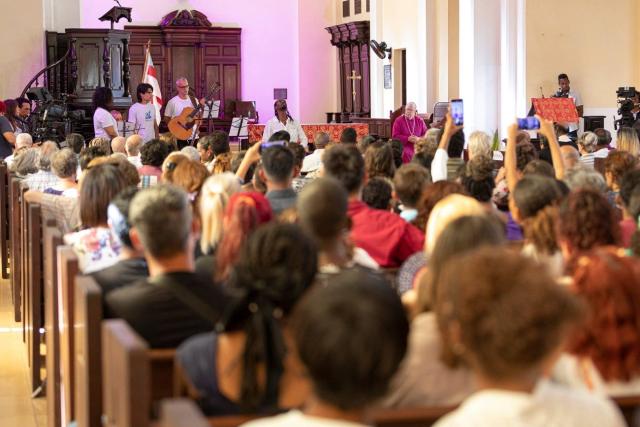
As the effects of the embargo and blockade by the current US administration increase the shortage of necessities for daily life in Cuba, an ecumenical delegation visited Cuban churches at the beginning of Holy Week. General Secretary Rev. Michael Blair and several global ecumenical leaders made a pastoral solidarity visit to Cuban churches, joining them in the start of a Holy week pilgrimage from March 28–31. The delegation observed the island’s long-honed resilience.
Ecumenical Solidarity
The international ecumenical delegation’s visit, initiated by the World Communion of Reformed Churches (WCRC), aimed to respond to the island’s deepening humanitarian crisis and growing global concern over the impact of economic sanctions on its people. Hosted by the Cuban Council of Churches, The Presbyterian Reformed Church of Cuba, and the Association of Reformed Churches in Latin America (AIPRAL), the delegates were:
- Rev. Philip Vinod Peacock, WCRC general secretary;
- Rev. Prof. Dr. Jerry Pillay, general secretary of the World Council of Churches;
- Rev. Jihyun Oh, stated clerk of the General Assembly of the Presbyterian Church (USA);
- Rev. Jimmie R. Hawkins, director of advocacy in the Presbyterian Church (USA);
- Rt. Rev. Anthony Poggo, secretary-general of the Anglican Communion;
- Rev. Michael Blair, general secretary of The United Church of Canada; and
- Rev. Dr. Reynaldo Ferreira Leao Neto, general secretary of the World Methodist Council.
The visit is a source of “healthy pride for the Cuban ecumenical movement,” says Joel Ortega Dopico, president of the Cuban Council of Churches. He notes that this visit is the result of many years of work, and marks the beginning of a stage in which the global ecumenical movement and the Cuban ecumenical movement will work closer together.
“Blessed are the peacemakers for they will be called children of God”
(Matthew 5:9)
More Sanctions
The delegation members call on the US government to choose the path of peaceful dialogue rather than threatening military confrontation. This is particularly relevant as President Trump signed another executive order against the country on Friday, May 1. Citing Cuba as an “unusual and extraordinary threat,” the order sanctions “any foreign person” operating in the “energy, defence and related materiel, metals and mining, financial services, or security sector of the Cuban economy, or any other sector of the Cuban economy.” Secondary sanctions are placed for conducting or facilitating transactions with those targeted under the order, including foreign financial institutions.
During the delegation, Rev. Philip V. Peacock, General Secretary of the World Communion of Reformed Churches, noted that, contrary to certain international perceptions, “the delegation found that Cuba does not constitute a threat but rather represents a benefit to many countries.” He adds that Cuba’s international solidarity, especially in the field of healthcare, has had a positive impact on numerous nations, demonstrating a sustained commitment to the well-being of other peoples.
Please add your voice to urge Canadian elected officials to increase humanitarian assistance, oppose the US oil blockade, and uphold Canada’s commitment to Cuba’s self-determination. Take action today.
Power for the People
The country’s goal of supplying 10% of the island with solar power is one response to a crippling fuel shortage brought on by decades of an embargo initiated by the United States, and the most recent blockade placed in February. The ongoing cycle of blockades means tourism is down, so incomes are down, which has widespread impact on individuals, says Rev. Blair.
“Cuba has thrived despite the embargo, but one wonders, what would it be like if there was no embargo?” says Rev. Blair. “We must continue strong advocacy. Our presence there helped Cuban partners to know that they’re not alone, that we understand and join in their struggle.”
Coincidentally, one of the first solar power project in Cuba was in the 1990s, with support from The United Church of Canada. Currently, hospitals, schools, funeral homes and long-term care homes are the government’s priority for connection to solar power. The delegation visited an oncology hospital, and it was here that the reality of scarcity set in—people with cancer can’t get radiation because there is no power, says Rev. Blair; children can’t get their medications, and people who need surgery can’t get surgery.
At the conclusion of the visit, the delegation discussed the possibility of convening an international ecumenical forum with the Cuban Council of Churches. The forum would strengthen solidarity among churches of the world with the Cuban churches and people, and raise awareness internationally of the cruelty and injustice of indiscriminate collective punishment on the Cuban people.