
As Koreans dream of lasting peace, human rights, and democracy, The United Church of Canada continues to stand in solidarity
Growing up in Canada, schools held Remembrance Day services, and John McCrae’s poem In Flanders Fields was always read. It left an indelible mark on me, especially the lines:
“If ye break faith with us who die
We shall not sleep, though poppies grow
In Flanders fields.”
Canada sent troops to fight in the Korean War (1950–1953), and 516 soldiers lost their lives. They would not be able to rest in peace knowing that the Korean Peninsula is still technically at war.
Beneath the glitter of K-pop bands, ever-popular K-dramas, and K-beauty products, there remains a profound sadness that many Koreans still carry. There remains a country still divided, unable to achieve peace. The threat of another war involving nuclear weapons lurks. Furthermore, young Korean men are required to serve in the military for approximately two years. Enormous amounts of energy and wealth are directed toward military expenditures—resources that could otherwise be invested in education, healthcare, and a more just and caring society.
Korean churches, led by the National Council of Churches in Korea (NCCK), one of our Mission and Service partners, are at the forefront of the peace movement. Recently, NCCK, the World Council of Churches, and the Christian Conference of Asia co-organized the International Ecumenical Peace Convocation with the theme, “Churches Cultivating Healing, Reconciliation, and Peace,” which I had the privilege of attending. NCCK recognized that achieving peace on the Korean Peninsula requires global solidarity and support. Because The United Church of Canada has supported the peace, human rights, and democracy movement for a long time in Korea, it was vital that we were there.
A Chinese proverb came to my mind, “When you are loved, you gain strength. When you love others, you gain courage.” In solidarity, God gives us strength and courage to tackle enormous challenges such as achieving peace on a land that is still technically at war.
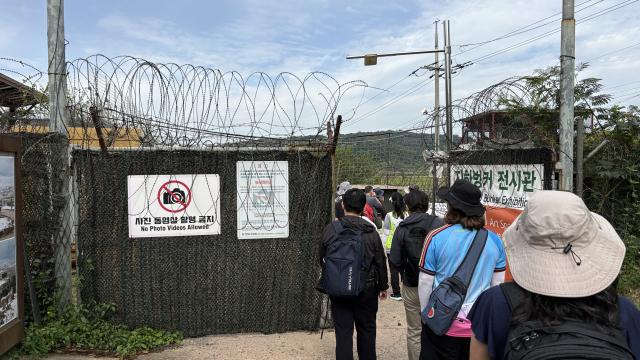
In addition to the conference, international ecumenical guests were invited to walk alongside the barbed-wire fences of the Demilitarized Zone (DMZ), one of the most heavily fortified borders in the world, as a pilgrimage of peace. We entered a dirt road through a gate surrounded by barbed wire. Once inside the DMZ, we were not allowed to take photographs. We walked in prayerful silence, reflecting on the situation.
What struck me was the beauty of the landscape: gentle mountains, a softly flowing river, and fertile farmland. Yet this beautiful scenery was affronted by barbed-wire fences on both sides of the pathway. They looked ugly and threatening. I felt a deep longing for them to disappear, for peace to prevail and render these barriers obsolete. This experience evoked a strong desire for peace, not only on the Korean Peninsula but also in the Middle East and other troubled regions around the world.
What brought me hope was the sight of large white birds. Devoid of human activity, the area has, in many ways, become a wildlife sanctuary. God’s beautiful creatures were able to fly freely, unconcerned by the artificial boundaries created by people. How I wish we could be so free as well!
We were also taken to the National Museum of Korean Democracy. The newly built museum stands next to a former Korean Central Intelligence Agency building that was used to interrogate and torture democracy activists. One of the restored rooms commemorates Park Jong-chul, a 21-year-old university student who died during interrogation as a result of torture. News of this revelation galvanized the public and eventually forced the military regime to allow democratic elections.
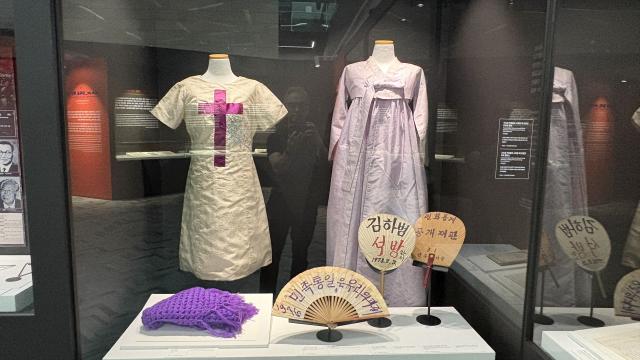
The museum also highlighted the role of churches in the democracy movement. I recognized the purple prayer shawls knitted by women’s groups in Korean churches and given to political prisoners as symbols of hope and solidarity. Members of The United Church also knitted and wore these shawls to demonstrate global ecumenical solidarity: that people around the world stood with Koreans in their longing for peace, justice, and democracy.
All of this left a strong impression on me. Democracy was achieved through extraordinary courage, perseverance, and the willingness of ordinary people to risk and even sacrifice their lives. I was deeply moved by the power of hope, the fearlessness of those seeking justice, and the faithful witness of Christians in Korea and around the world.
At the conference, Dr. Mitri Reheb, president of Dar al-Kalima University reminded us, “Jesus said, ‘Blessed are the peacemakers’ not peace talkers.” Truly, we are called to be peacemakers. We can live into peace by seeking justice. We do this because we are called to love one another. Perhaps then, those who fought and died for peace can finally rest in peace.
—Rev. Won Hur works as the Global Partnership Program Coordinator for Asia in the General Council’s Church in Mission Unit
Read more
Praying for Peace and Reconciliation in Korea
80 Million Hearts Broken as Korea Summit Talks Cancelled
Seodaemun House, Seoul, and a Defining Moment in Our 100-Year Story
The views contained within these blogs are personal and do not necessarily reflect those of The United Church of Canada.