A tribute to a beloved friend of many and diaconal minister of the United Church, who risked her life to demand democracy in Korea
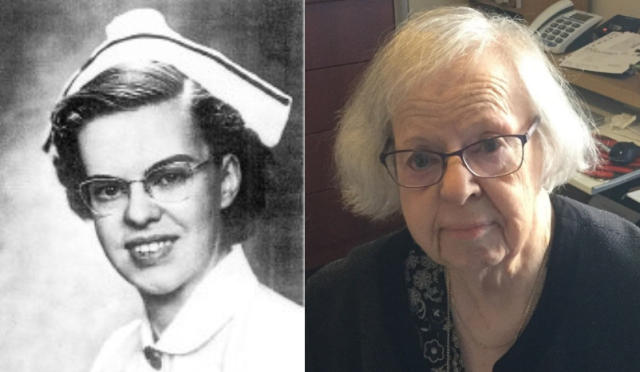
Marion Pope, known also in Korea by her Korean name 방매륜 (Bang MaeRyun) was a member of the United Church, who upon being sent to Korea, made profound impact. In Korea, she distinguished herself in nursing, music, and evangelization, but is particularly noteworthy for her contributions to the Korean democratization movement. Like so many who served the church overseas, her story is largely unknown in Canada, though she is remembered with great tenderness by those who received her.
Alice Marion Pope was born in Toronto on March 1, 1928, a date that prophesied her life calling. Nine years earlier, on March 1, 1919, an independence movement was launched in Korea by citizens who wished to rid themselves of Japanese colonial government. On March 1, 1976, Marion would play a key role in an event that would have profound repercussions for Korean democratization.
As a young woman, Marion studied nursing, but she also felt a calling to some form of Christian leadership. In 1955, after completing the course of study for diaconal ministry at the United Church Training School (UCTS), she was commissioned to serve as a missionary. She was sent to Korea in 1957.
Fighting for Democracy
In Korea, she joined a group of Canadian missionaries working to help rebuild the church and society following a devastating war that cost Korea three million lives and ended with the division of the peninsula, and that of countless families. After a period of autocratic leadership, Korea established a democratic government in 1960 which was soon eliminated by a military coup. Marion witnessed these events and joined her Korean friends in opposing them. The church with which she and other Canadians worked closely, the Presbyterian Church in the Republic of Korea (PROK), was particularly involved in this struggle.
In 1964, Marion was sent to work at the Kwangju Christian Hospital in the southeast of the peninsula. She developed outreach health services in rural and urban communities. Always working to upgrade her nursing skills, Marion completed graduate studies and moved to Seoul to teach nursing at Ewha Women’s University. In Seoul, she participated in the March 1 Declaration for National Salvation, a protest event opposing the increasingly repressive dictatorship.
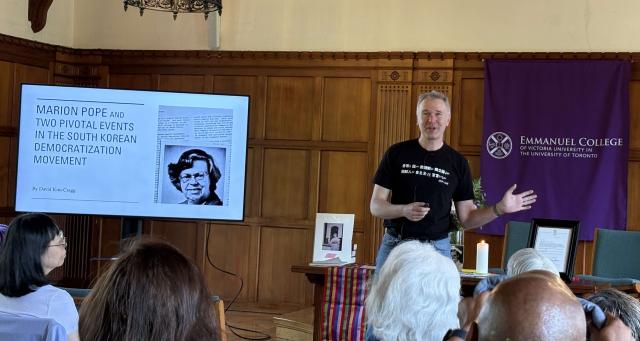
Marion, together with fellow Canadian mission personnel Marion Current and Willa Kernen, plotted with activist Lee Oo Chung to transport the text of a document critical of the government into the venue, from which it was openly broadcast. Their plan also predicted the arrest of their friend and the need to swiftly get news out regarding the government crackdown. Her efforts were critical to the success of that protest, which raised awareness of the Korean Democratization Movement nationally and internationally.
In 1980, Marion returned to Kwangju. She arrived as martial law was being imposed across the country in another military crackdown. While in the city, she bore witness to a brave act of resistance on the part of its citizens and horrific violence perpetrated against them by the South Korean army. Thousands lost their lives.
Marion elected to stay, though she could have extricated herself at any time. She treated the injured and recorded events for posterity. In time, she was able to help people escape and get news out of what had happened. Her testimony is among some of the most vivid and moving accounts given by foreigners to the Kwangju uprising and massacre—read an excerpt in the Downloads section at the bottom of this page.
Marion moved on to complete a doctoral degree in nursing, along with Margaret Storey, another United Church missionary nurse, at Yonsei University, in Seoul, Korea. Her dissertation was written in Korean! Marion helped train a generation of nurses in Korea. In 1987, she returned to Seoul to teach again at Ewha Women’s University. And in 1993, she retired to Canada.
A Legacy That Remains
Throughout her time in Korea, Marion attended church and involved herself in the life of the congregation and its community. She had a special gift for music and usually sang in and accompanied the choir, sometimes even serving as choir director. She took an active interest in Korean culture and history. She promoted the use of Korean dress and music in church. Using her familiarity with Korean music form and language, she translated Korean hymns into English for a Canadian audience, a number of which have been included in United Church hymnary.
Marion’s accomplishments have not gone totally unnoticed in Canada. She was honoured as a Companion of the Centre for Christian Studies (the successor to the UCTS) in 2003. In 2005, she was given the Katharine Hockin Award from the Canadian Churches Forum for Global Ministries for "service with distinction in a cross-cultural mission setting."
But it is in Korea, and the hearts of those she taught and of those with whom she struggled for democracy, that Bang MaeRyun is most highly cherished.
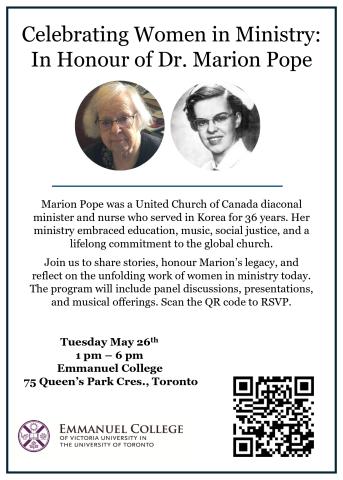
Marion passed away in Toronto on July 5, 2025. This May, her witness to the Kwangju uprising was featured in a documentary by South Korea’s national broadcaster. The same month, an event celebrating the work of women in ministry was held in her honour in Toronto at Emmanuel College.
—Rev. Dr. David Kim-Cragg is a minister of St. Matthew's United Church and an adjunct professor at Emmanuel College who served for three years as overseas personnel in South Korea. He is the author of Water From Dragon’s Well, an award-winning book about the relationship between The United Church of Canada and Presbyterian Church in the Republic of Korea.
The views contained within these blogs are personal and do not necessarily reflect those of The United Church of Canada.
Downloads
- Marion Pope Journal Entries (University of Toronto Archives) (177.65 KB) (PDF)