Rev. Dr. Japhet Ndhlovu on revisiting the ecumenical roots of his ministry, and the crucial need for global Christian collaboration

Nestled in the green hills outside Geneva, Switzerland, the Bossey Ecumenical Institute is a quiet, beautiful place where the paths are lined with trees and the chapel calls you to prayer before the agenda calls you to work. It is a place that invites you to slow down, to listen to God, to one another, and to the cries of the world.
Last month, I returned to Bossey with my colleague, Wendy Gichuru, Global Partnership Team Lead at the United Church. Over four days, we joined representatives from around the world in three back‑to‑back gatherings: the “Working Together 2026” meeting of the World Council of Churches (WCC), a High‑Level Strategic Consultation on Ecumenical Cooperation, and the ACT Alliance Working Together meeting.
We prayed, reflected, and wrestled with a pressing question: What is God calling the ecumenical movement to be in a time of overlapping wars, climate catastrophe, shrinking resources, and deep injustice?
At the heart of our time together was the Strategic Consultation, which created space for honest, forward‑looking dialogue among senior leaders of the WCC, the Lutheran World Federation, ACT Alliance, and ecumenical specialized ministries. Its central objective was to discern strategic priorities and shared responsibilities for ecumenical collaboration. We explored the value and potential of acting ecumenically in a world that urgently needs common, credible Christian witness.
As Rev. Prof. Dr Jerry Pillay, WCC General Secretary, reminded us, “our coming together is not merely institutional – it is profoundly theological, missional, and urgent in light of the world we are called to serve.”
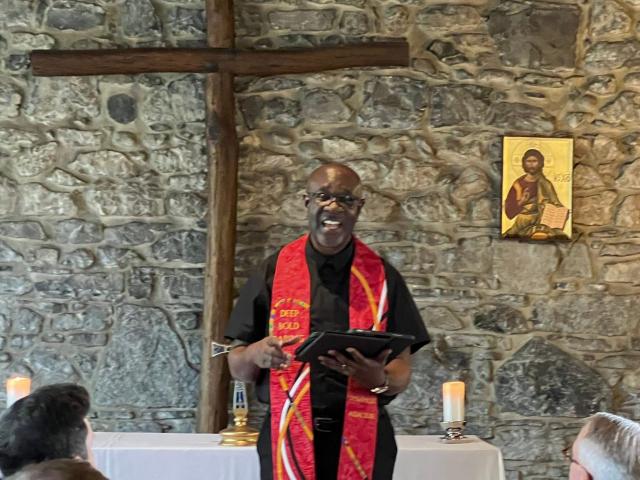
Bossey, Place of My Formation
For me, though, these were not just other meetings in a busy calendar. It was a homecoming. My relationship with Bossey and the WCC goes back more than three decades. In the 1990s, I came here as a young steward for the WCC Central Committee, not knowing that those days were quietly re‑wiring my imagination.
At Bossey I first saw a church that was larger than any single denomination or nation. I saw Orthodox and Protestant, North and South, old institutions and young movements, all trying—often imperfectly—to walk together. I learned that “ecumenical” means a discipline of listening across difference, of holding together justice and unity, of believing that the Holy Spirit speaks in accents not our own.
"Hope happens when people who love the church enough to critique it also love it enough to stay at the table, to reimagine structures, to risk new forms of collaboration, and to trust that the Spirit has not finished with us."
Later, I returned for an intensive formation course for future ecumenical leaders. Studying with peers from around the world, we were pushed to ask hard questions about power, colonial history, and the role of the churches in conflict and reconciliation. The seeds planted there would, bear fruit in ways I could not have predicted.
This was long before I became Moderator of the Reformed Church in Zambia and General Secretary of the Council of Churches in Zambia, before my years with the All Africa Conference of Churches, and before my current role as Executive Minister for the Church in Mission with the United Church of Canada. Bossey did not give me a career plan; it gave me something more precious: an ecumenical vocation.
Working Together in “A Season of Shaking”
Coming back now, I carried those memories into a very different context from the 1990s. We spoke of worshiping and working in a “season of shaking”: climate breakdown that devastates communities; endless wars and occupations; growing authoritarianism and religious nationalism; and economic systems that sacrifice the vulnerable.
On top of this sits a set of very practical pressures: diminishing funding in many traditional partner churches, painful staff reductions, and overlapping mandates between global ecumenical bodies.
We asked hard questions: Where are we still working in parallel? What must we stop doing alone? What are we willing to let go of, for the sake of the whole body of Christ? This is exactly where the Strategic Consultation tried to focus our attention. Its objective was not merely to name our crises, but to identify shared priorities and responsibilities that would help us move from fragmented efforts to intentional collaboration.
A Hopeful, Forward‑Looking Call
In Romans 5, Paul offers a strange sequence: affliction, endurance, character, hope. Hope does not come instead of affliction; it is born through it. That feels true of the ecumenical movement today.
We are facing real afflictions. Yet in the endurance of churches and agencies that keep showing up, in Ukraine and Congo, in small Canadian congregations and in vibrant African and Asian communities, I see character being formed: a deeper honesty, a more decolonial awareness, a growing insistence that we must work together rather than side by side.
My time at Bossey this year renewed my conviction that hope is not wishful thinking, but a disciplined, communal practice. Hope happens when people who love the church enough to critique it also love it enough to stay at the table, to reimagine structures, to risk new forms of collaboration, and to trust that the Spirit has not finished with us.
For me, it was also a reminder that God wastes nothing. The young steward of the 1990s, the student in the ecumenical formation course, the Moderator in Zambia, the continental church leader, and my present are not disconnected chapters. They are one story, braided together by grace.
Returning to Bossey, I found myself praying that our church will continue to invest in ecumenical formation for youth, for emerging leaders, and for those who will come after us. The gifts we most need are not only technical skills, but hearts and imaginations trained to see Christ’s body in all its diversity and to work for its unity and witness. That is the gift Bossey gave me, one I long to share with gratitude and hope, in the ministry we live together as the United Church of Canada.
—Rev. Dr. Japhet Ndhlovu is Executive Minister, Church in Mission with the United Church of Canada General Council Office
The views contained within these blogs are personal and do not necessarily reflect those of The United Church of Canada.