
Heads of United Church theological schools and General Council Office meet to agree on funding priorities
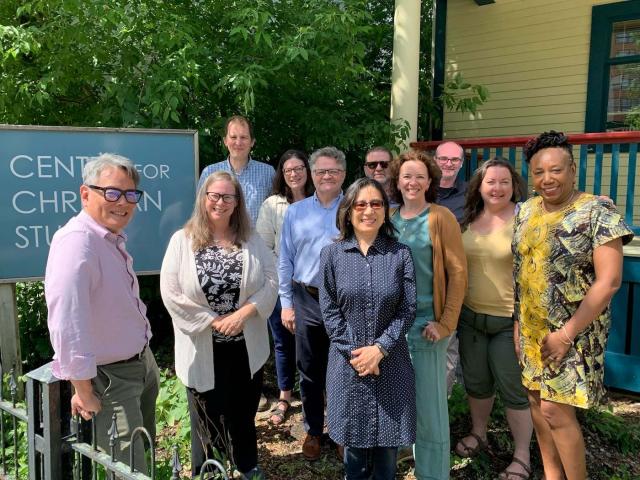
The Reimagining Theological Education project continued to gather momentum last week with a meeting of the heads of the eight theological schools affiliated with The United Church of Canada and General Council Office (GCO) staff.
Meeting in Winnipeg, the group discussed a range of ideas and proposals for developing theological education, to better equip ordered and lay ministry leaders to provide hope-filled, adaptive, and effective leadership and to support pastoral leaders to navigate the challenges of ministerial life. Particular attention was given to ways to develop the curriculum being taught, both as part of the core ministerial training and to support recent graduates as they move into pastoral leadership.
New innovations to come
Innovative educational formats and contexts will be explored throughout this project, with Sandy-Saulteaux Spiritual Centre and the Centre for Christian Studies, both in Manitoba, looking to widen access to their collaborative programs.
Emmanuel College in Toronto and the Atlantic School of Theology (AST) in Halifax have each developed initiatives to support ordered ministers as they transition beyond academic life. Emmanuel will partner with the General Council Office to develop and pilot an approach to Supervised Ministry Education that emphasizes peer support and connection. Similarly, AST will collaborate with the GCO to establish continuing education offerings targeted at graduates in their first five years of ministry.
Public scholarship will be encouraged through initiatives led by the Vancouver School of Theology (VST) and St. Andrew’s College in Saskatchewan. VST are in the process of recruiting a professor of theological ethics, with a clear focus on contemporary issues confronting everyday Christians, ranging from AI to MAID. St. Andrew’s, meanwhile, will look to further foster international scholarly exchange and encourage public engagement in topical research conversations.
“I’m excited that this grant gives our schools and the church resources to collaborate and experiment beyond ‘business as usual,’” —Rev. Dr. Jennifer Janzen-Ball, Executive Minister, Theology and Ministry Leadership
Improved congregational engagement is also a priority for this work, and several schools are developing courses and programs aimed at supporting and engaging with communities of faith, and particularly with those who do not employ a dedicated pastoral leader. St. Stephen’s College in Edmonton plans to implement a Faith and Leadership program, engaging communities in collective study and spiritual growth. Montreal Dio are likewise designing new programs to support communities of faith—as communities, and also in community. These initiatives are committed to helping communities grow into new visions of ministry, providing faith-led leadership in a variety of contexts.
The General Council Office, through the Office of Vocation, will assess existing experiential learning for ministry candidates and create pilot supervised ministry education sites, to strengthen learning and formation in the practice of ministry. These pilots will include structured learning-in-community for lay leaders and ministry candidates, as well as peer support cohorts for ministry candidates.
Collaboration widens scope
A major overall focus of the Lilly Grant is improving and supporting collaboration between the schools, and this was frequently emphasized in discussions. Collaborative projects between schools are being developed, to maximize the scale and scope of work funded by the grant. Additionally, renewed efforts are being planned to enable course sharing across all eight institutions, increasing the range and availability of specialist subjects for all students.
The proposals approved at this meeting reflect a six-month process whereby the schools engaged in an in-depth planning process with a wide range of their individual stakeholders. They reflect each school’s unique charisms and are tailored for the specific theological contexts that the schools aim to serve. Together, the proposals engage the full scope of pastoral leadership and theological education in Canada, while also seeking to strengthen ecumenical connections through their work.
“I’m excited that this grant gives our schools and the church resources to collaborate and experiment beyond ‘business as usual,’” said Rev. Dr. Jennifer Janzen-Ball, Executive Minister, Theology and Ministry Leadership at the GCO. “The United Church and its theological schools recognize each school’s unique gifts; this project allows for those gifts to collectively strengthen the ecosystem of theological education within the United Church, and hopefully benefits theological education ecumenically in Canada.”
The work being undertaken for the Reimagining Theological Education project is closely linked to the wider strategic plan of The United Church of Canada, Toward 2035. The project is funded by a large-scale collaborative grant from the “Pathways to Tomorrow” program of the Lilly Endowment, which was announced last December.
For further information, please contact Gill Le Fevre, , Director, Reimagining Theological Education Project, at the United Church General Council Office.