Following the mass killing last month by the Philippine military, we must hear the call of peacemaking and draw attention to injustice
The United Church of Canada joins global and ecumenical partners and communities of faith in expressing deep concern and grief over ongoing violence in the Philippines, particularly in Negros Occidental.
On May 12, Rev. Sadie Stone, a minister of the United Methodist Church and a member of the Global Council of the International Coalition for Human Rights in the Philippines (ICHRP), was denied entry at Manila Airport while seeking to participate in a fact-finding mission. She had intended to help investigate the killing of 19 individuals in Negros Occidental on April 19, 2026.
Among the civilians killed were community journalist RJ Nichole Ledesma, university students Alyssa Alano and Maureen Keil Santuyo, community researcher Errol Wendel Chen, Filipino-American advocates Kai Dana-Rene Sorem and Lyle Prijoles, local resident Roel Sabillo, and two unnamed minors. We join Filipino human rights organizations, churches, and the wider international community in calling for a thorough, independent, and impartial investigation into these killings.
This violence is part of a longer history. On September 20, 1985, the Escalante Massacre in Negros took the lives of over 20 people and injured many others. The pain of that day echoes there through generations.
Together with partners, including the National Council of Churches in the Philippines and ICHRP, The United Church affirms the call to a just peace—a peace grounded not only in the absence of conflict, but in the presence of justice, dignity, and right relationship. Such peace requires that unjust systems be named and transformed.
The history of Negros Occidental reflects deep inequalities rooted in colonial and economic structures. Wealth generated through the sugar industry has long been unevenly distributed, leaving many farmworkers in conditions of poverty and vulnerability. Calls for land reform, living wages, and equitable services have too often been met with violence. Today, these patterns persist, with many communities continuing to face hardship, displacement, and insecurity.
As Asean Parliamentarians for Human Rights state: “These killings follow a pattern of state-enabled repression. The Anti-Terrorism Act of 2020—allowing warrantless arrests and detention without charge—has been weaponized against journalists, activists, and community workers....labeling critics as communist sympathizers, operates as a precursor to violence.”
The National Council of Churches in the Philippines, a The United Church partner, urges “the Philippine government to strike a new tone and welcome not only Rev. Stone but all human rights defenders currently ‘blacklisted.’ We must strive to respect rights, restore freedoms, and embrace the common good which can be strengthened through the efforts of international solidarity partners.”
The United Church believes that God stands with marginalized and oppressed peoples, and calls us into the work of justice. In a spirit of prophetic solidarity, we stand with all who uphold the sacred dignity of life. Together, we affirm that every person is worthy of respect and protection, that violence against the vulnerable is a profound injustice, and that truth-telling is essential to peace.
Canada’s public witness and diplomatic engagement should contribute to the pursuit of justice and lasting peace.
Reflect
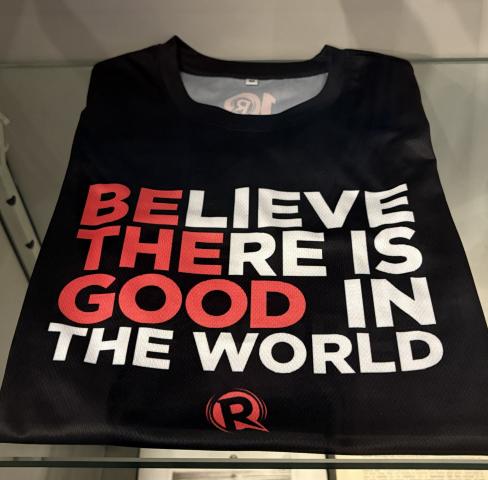
The T-shirt above, donated by Maria Ressa—the 2021 Nobel Peace Prize laureate—emerged from a place of struggle and honest questioning. Among her colleagues, there were some who found it difficult to believe there is good in the world. Yet, through dialogue and discernment, a gentle but powerful call was added: “Be the good in the world.”
- As you sit with these words, take a moment to be still.
- What rises within your heart? Do you sense hope, longing, uncertainty, or a quiet invitation?
- Even amid brokenness and injustice, where do you glimpse signs of God’s goodness at work?
- In your own life of faith, how might God be calling you to embody that goodness?
How might your church become a living witness?
May this invitation not only be something we reflect upon, but something we prayerfully live into—trusting that even the smallest acts of goodness can become vessels of grace in the world.
Prayer
God of justice and compassion,
You call us to be peacemakers in a world that longs for healing.
Be present with those who grieve,
those who live in fear,
and those who continue to struggle for dignity and justice.
Strengthen all who seek truth.
Guide leaders in the ways of accountability and peace.
Move our hearts beyond silence into faithful action.
Help us to walk together—across communities and faiths—
in solidarity and hope,
trusting in your vision of a just and peaceful world.
Amen.
This blog was written by members of The United Church of Canada General Council Office. The views contained within these blogs are personal and do not necessarily reflect those of The United Church of Canada.