
One year after the United Church’s 2025 apology, Ruth Noble reflects on its impact, ongoing conversations, and efforts to support healing and share history.
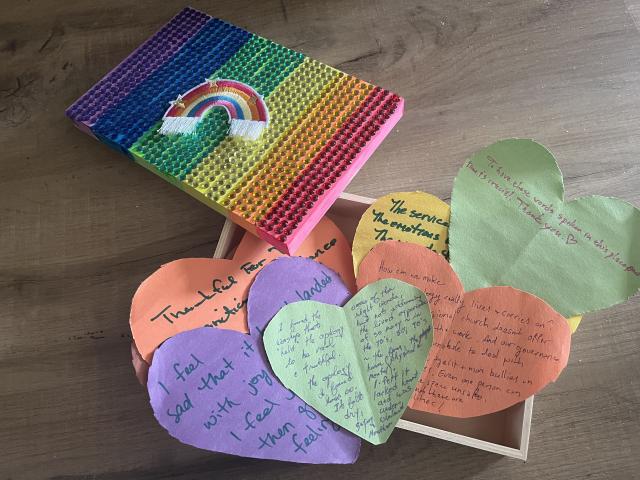
Over the past year, there have been many conversations about the apology on August 8, 2025. Some of these conversations have been with people reflecting on how they felt a year ago when they heard the apology. Some have asked about the history and why the apology is significant. And some have been wondering about next steps.
All of these conversations have been very meaningful for me. I believe it is important to keep the conversation going.
The preparation for the apology a year ago was also framed in conversation. Two days before General Council 45, 2S and LGBTQIA+ commissioners and other leaders gathered for community-building. To explore what is happening in the world to 2S and LGBTQIA+ peoples, ecumenical partners told stories of the challenges they face. In more than 60 countries in the world, it is dangerous to be Queer.
We heard stories from those who were in leadership at the time of the 1988 decision—about the struggles to be out and of struggles faced today, including legislation against Trans rights and book-banning. The fact was not lost on any of us, then, that we were gathering in Calgary, Alberta, a province that has passed many pieces of anti-Trans legislation and issued a long list of books to ban in schools.
We met with the Moderator, General Secretary, and worship leaders for the apology worship service, which took place on August 8, 2025, at Knox United Church. At the time, there were many questions about who would be saying the apology, and what the next steps would be.
The worship service was very emotional for me. I remember 1988. All these memories I had buried rose to the surface, and I thought about those who have passed on who wouldn’t hear the apology. After the service, groups of us gathered—one at Knox United Church, one at the convention centre, and one online. The conversations were deep, emotional, and healing.
There was hope expressed for the next steps, to remember and re-tell the stories from the Iridesce Project. We had youth in our circles who asked questions about our history; it became evident to those gathered that we have not shared our history enough, and we need to lift up what has been forgotten for the sake of younger generations.
Others who had difficulty speaking about how they were feeling were offered the opportunity to write their reflection on paper hearts. I have them in a rainbow box. I want to share one of them here: “The service was meaningful, deep – full. The words themselves – not as big an impact – but as we heard – the work has just begun. I’m willing to engage the work!”
One year later, the work is underway.
Affirm United/S’affirmer Ensemble held a webinar on apologies in September 2025; six months later, we followed it up with another webinar. On the Affirm United website, we have a Lenten resource and other reflection resources centred on the apology and the history of the 1988 decision and beyond for individuals and communities of faith to use.
The United Church of Canada has created a working group, and we at Affirm United/S’affirmer Ensemble are privileged to be part of this group, along with an incredibly diverse and wise group of committed leaders in the church. The group has been meeting since the autumn of 2025. It has created resources for worship and a pull-out section on apologies that was in the June edition of Gathering and which can also be found on the United Church website. We held another webinar in June. Many leaders of the working group have spoken at their regional council annual meeting as well.
The working group is continuing the work of “Living Into the Apology.” The group takes all the information that helped create the apology—from the founding groups of Affirm United/S’affirmer Ensemble, to the stories of Iridesce and its recommendations, to the work of task group that created the apology—into our work so that we can create a meaningful healing response to the apology.
This work takes time, and I, for one, am grateful to be on this journey of faith and conversation.
Ruth Noble (she/they) is Executive Director of Affirm United/S'affirmer Ensemble.
The views contained within these blogs are personal and do not necessarily reflect those of The United Church of Canada.