
On a Canadian Foodgrains Bank Learning Tour to Kenya, Charlie McIntosh witnessed the impact of financial empowerment on local communities
The United Church of Canada is a member of the Canadian Foodgrains Bank (CFGB), a membership of 15 churches and church-based agencies across Canada. Through CFGB, The United Church accompanies global partners in Kenya and Zimbabwe as they work to address food insecurity in communities affected by climate change and systemic injustices. Together, global partners, CFGB, and The United Church share a commitment to advancing food sovereignty and upholding the dignity of all people.
Learning Tours are opportunities for people to learn firsthand about how CFGB and its members and partners contribute to promoting food security for families and communities, as well as to learn more about Canada’s global role in agriculture and food security.
Earlier this year, I participated in a CFGB learning tour in Kenya alongside Shauna McIntosh, visiting partner-sponsored projects in three regions of Kenya. In Matumaini—a very dry area with frequent droughts—Church World Service works with 12 villages, in partnership with Alongside Hope (an outreach ministry of The Anglican Church of Canada). We then travelled to lush, high-altitude Embu county, where we were hosted by African Christian Church & Schools; a partner of Canadian Baptist Ministries. In the Kibwezi area, we visited projects managed by the Utooni Development Organization in partnership with the Mennonite Central Committee.
Although sponsored by different organizations, each project shared a feature: they introduced Village Savings & Loan Associations (VLSAs), microbanks that allow their members (25 to 30 in these cases) to deposit and borrow money.
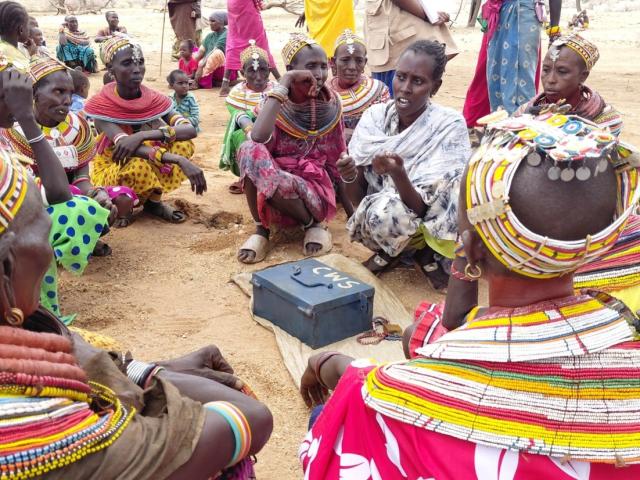
Partner organizations in Kenya introduced the VLSA concept, and educated people on how to make it work for their community. Each group had a metal box secured by three padlocks used to hold the money, which were each held by different people. Different responsibilities were assigned: some would count the money, others would keep records or conduct meetings. Groups would decide how much money each member would deposit at meetings, and each person would have a passbook to keep track of their deposits, loans, and repayments.
VLSA members are allowed to borrow funds from the association’s deposits, with most loans required to be repaid in three months. They can then use the money to buy seeds to plant, build a chicken coop, or pay school fees for their children, to name a few possibilities.
This gives members, who are mostly women, an unprecedented opportunity to make financial decisions independently. Each group also has a social fund that members contribute to, which can be used to help if for instance a member has a baby or a death in the family.
In Embu, we attended a VLSA meeting to see how they operate firsthand. The roughly 35 groups of the area have a combined savings of about 12,000,000 Kenyan shillings (or $120,000 Canadian dollars). At the end of the year, each VLSA cashes out their funds, giving all the money back to their members, before the cycle of monthly deposits begins again.
We witnessed how VLSAs deeply empower their members, creating financial opportunities through community solidarity that can be incredibly transformative. The only investment required to start one is that needed to train members and for a metal money box. It struck us powerfully how much a little outside investment, through organizations like the Canadian Foodgrains Bank and its partners, can make a large impact on recipients in countries like Kenya.
Myself and Shauna McIntosh would like to thank the Canadian Foodgrains Bank for the opportunity to participate in the 2026 Learning Tour to Kenya, and for The United Church of Canada for supporting us in this trip.
The four United Church participants of the CFGB's Food Security Learning Tour to Kenya are all eager to share their experiences. If this blog piques your interest to participate in people-to-people opportunities with global partners or invite a speaker, we invite you to find out more at the People in Partnership webpage or contact .
The views contained within these blogs are personal and do not necessarily reflect those of The United Church of Canada.