Jane Thirikwa reflects on advocating with Rainbow Pilgrims of Faith at the World Council of Churches in Switzerland this month
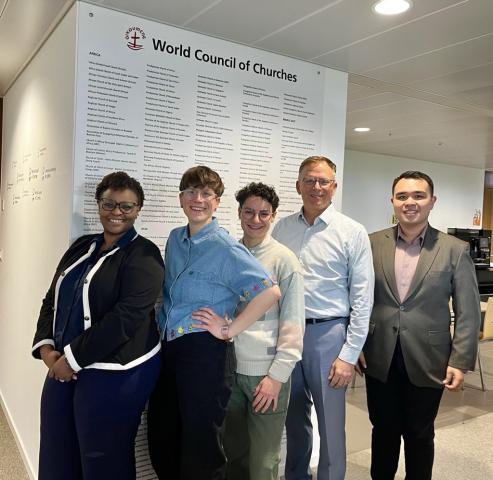
A delegation from Rainbow Pilgrims of Faith (RPF)—a global network of which The United Church of Canada is a member—recently gathered at the World Council of Churches (WCC) in Geneva for a series of conversations focusing on advancing inclusion, theological dialogue, and advocacy on gender and sexuality within global faith contexts. The delegation met with Rev. Prof. Dr. Jerry Pillay, WCC General Secretary, and WCC program staff in health, mission, youth, communications, and theological education.
The wide-ranging discussion highlighted both the challenges and emerging opportunities for dialogue, participation, and justice in a global church context marked by diverse theological perspectives and social realities. At the heart of the conversations was a shared recognition that this is a critical moment for churches worldwide. They exist in a complex global environment—shrinking civic space, political pressures, and religion-induced discrimination and exclusion further marginalize 2S and LGBTQIA+ people of faith and communities.
While the discussions acknowledged the complexity of navigating global differences in theology and context, there was agreement that, alongside these challenges, there is also a profound opportunity to strengthen relationships and deepen commitment to justice and dignity for all.
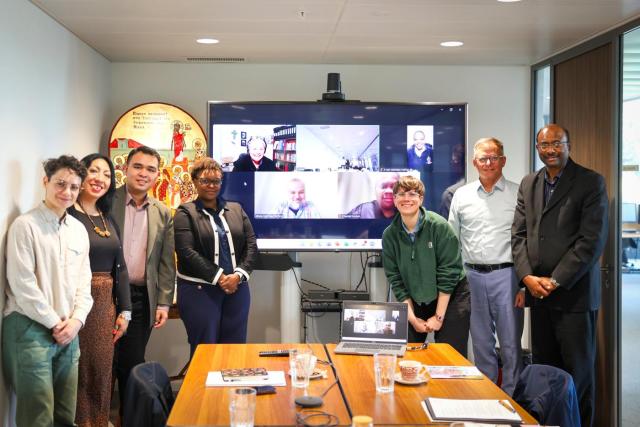
As Rev. Pillay said, “there was growing emphasis at the WCC on ‘mission from the margins,’ an approach that intentionally centres voices that have historically been excluded, but which have a profound contribution to mission.” He noted the intentional inclusion of 2S and LGBTQIA+ communities as an important commitment to addressing injustices wherever they occur.
“We’re not talking about people outside there. We’re talking about people amongst us,” he said.
The RPF delegation showed how personal testimonies of 2S and LGBTQIA+ people foster empathy, and open pathways for theological reflection grounded in real life. This framework creates meaningful entry points for participation, which often begins not with policy, but with relationship, listening, and the courage to speak truth through lived experience. This principle resonates deeply with the United Church’s call to seek justice, dignity, and fullness of life for human beings and for all our relations within God’s beloved creation.
Participants highlighted how personal lived experiences shared in safe and respectful spaces have already begun to shift attitudes within church leadership and global ecumenical structures. For the United Church, which has long affirmed the importance of storytelling in faith and justice work, this approach reflects a familiar and powerful practice of bearing witness to God’s love through the lives of the community.
Dialogue Matters
Another key outcome of the meetings was an affirmation that dialogue remains essential. WCC leadership emphasized that though human sexuality and gender diversity could be divisive topics in churches and in fellowship, ecumenical dialogue in a safe space is welcome in journeying together in ethical dilemmas. Keeping conversations open is itself an act of justice and hope.
Another strong call emerging from conversations was the need to centre youth voices and leadership. Young people, including LGBTQIA+ youth, are seeking to be fully part of shaping the church today.
Participants also highlighted diverse regional realities. In many parts of Africa, Asia, and Europe, LGBTQIA+ people continue to face stigma, legal barriers, and even conversion practices or similar threats. These realities reinforce the urgency of creating spaces of safety and pastoral care, where faith and identity can coexist without harm.
A Shared Commitment
While much work remains, the meetings between the World Council of Churches and Rainbow Pilgrims of Faith reflect growing trust, mutual respect, and a shared commitment to moving forward together. The work of further integrating 2S and LGBTQIA+ perspectives into global mission work continues—the WCC now prepares for the 2028 World Mission Conference and its 12th Assembly, scheduled for 2030.
The gathering concluded with a shared commitment to continue building relationships, learning across differences, and fostering spaces where all people are recognized as part of God’s creation. As one participant reflected, the ongoing task is to ensure the church remains a community where justice, healing, and welcome are lived realities.
—Jane Thirikwa is Program Coordinator, Global Advocacy 2S and LGBTQIA+, at the General Council Office.
The views contained within these blogs are personal and do not necessarily reflect those of The United Church of Canada.